
The story of Birkat al Mauz
“One can never evade the beauty of past ruins evolving into future reminiscence” — Swati Basu Das
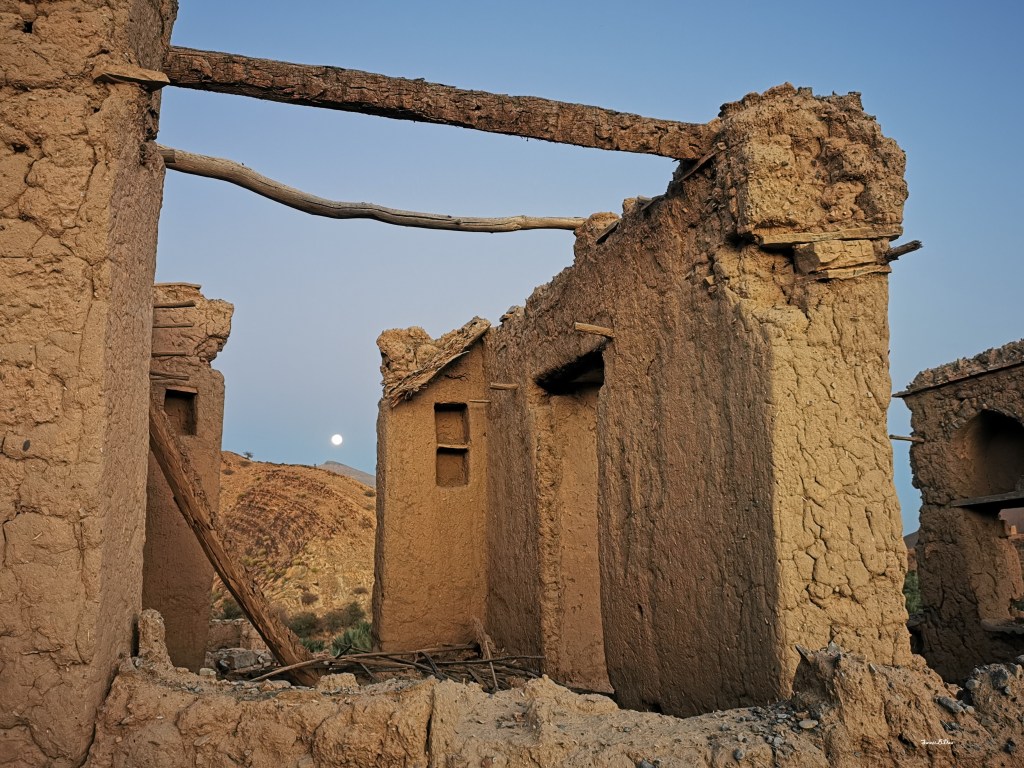
Silence creeps into its fragile lap. Its crumbled walls
reflect the glimpses from the olden days and faint
whispers from past echoes into the oblivion. It lay
eroded under the enormous blue sky. It shivers
when the soft breeze blows caressing its wrinkled
structure. A lush green farms fringe its ruined
borders. Burbling aflaj meandering through its alley
splashes a daily dose of nourishment to the
plantations.
Welcome to the ancient city of the Sultanate of
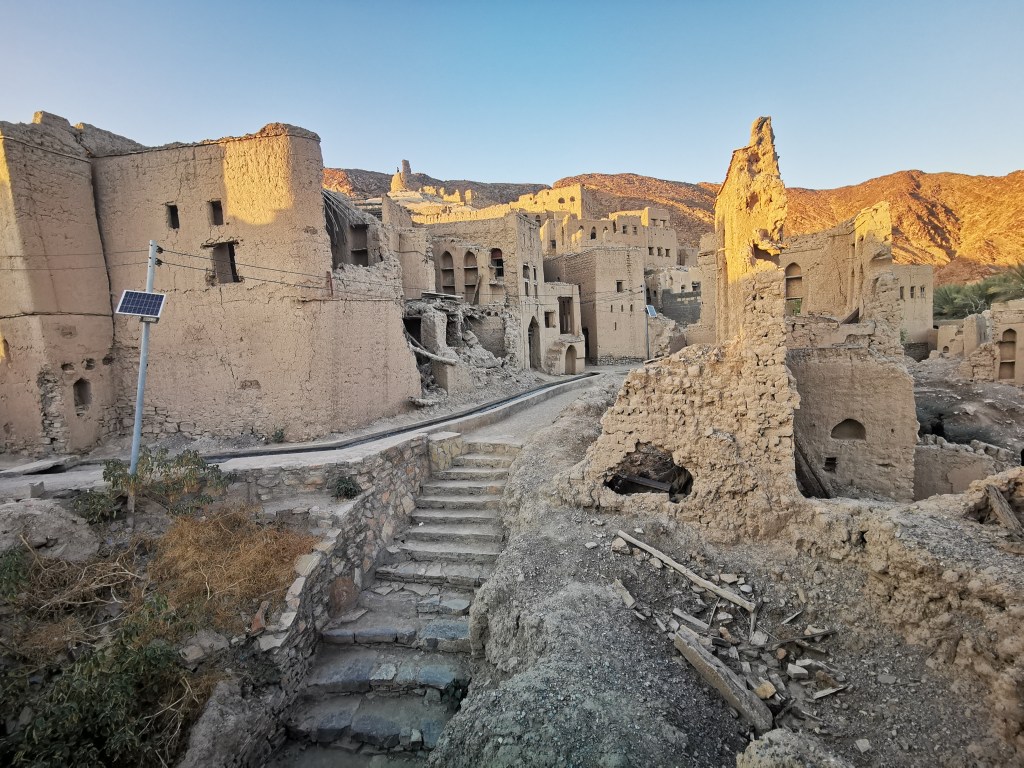
Oman – Birkat Al Mawz. A heritage village dating
back to the 17 th Century AD, Birkat Al Mawz is
located on the way to Jabal Al Akhdar and is a
fascinating stopover before ascending the Al Hajjar.
This ruined vernacular settlement jutting out of a
craggy backdrop slides down into the valley of the
Al Hajjar at the base of Jabal Al Akhdar.
The roofs of these tattered uninhabited dwellings
have collapsed, the floors shake with each footstep,
and the walls and wooden planks infested with termites.
Despite the dilapidation, Birkat Al Mawz is but an architectural wonderland.
The soil and water from the wadi are mixed to build
these typical old mountainside mud-homes. The
water content in the soil is adjusted and seasoned
for two months to build the houses.
“This is a typical way of building a mud house. Each
house has a shelter built for the cattle on the
ground floor and large storage rooms for grains and
dates on the lower-ground floor. Alongside the
entrance, one can spot the majlis (meeting area).
The ceilings were decorative features. Each wooden
door of the house has intricate carvings. The first
floor had kitchens and washrooms. The top-level
consists of bedrooms, terraces and meeting area for
the ladies,” Ali Bin Hamood Al Mahrooqi,
administrative manager, Journal of Oman Studies at
the Ministry of Heritage pointed.
The dwellings in Birkat Al Mawz overlap one
another, making it seamless. It symbolises the
typical Omani hill-type settlement and indicates a
close tribal and familial relationship and bonding.
The nine tribes Al Tawbi, Al Fahdi, Al Sarqi, Al
Riyami, Al Siyabi, Al Na’bi, Al Abri, Al Rukaishi and Al
Hadrami inhabited this ancient city and still reside
in their new homes further from the ruins.
“All these groups belong to the dominant Al Riyami
tribal confederation either closely associated with
them like the al Siyabi tribe or as direct descent
groups like the Al Fahd, Al Tawbi and other tribes,”
Ali Al Mahrooqi explains.
Determining its course through Bait ar Rudaydah (a
famous castle) a falaj system passes this village
helping the oasis maintain its greenery. A UNESCO
World Heritage site, Falaj al-Khatmeen is a 2,450
metres long rain fed Dawoodi falaj.
“Its source is the rainwater that floods wadi al-
Mauydin. Several smaller channels running down
the hills extend to the north and south truncating
the east-west linearity of this oasis. It is the only
source of water at Birkat Al Mawz,” Ali Al Mahrooqi
pointed.
The old denizens have shifted to their modern
homes, and many now live in the city neglecting the ancestral properties. The quest for modernism might soon witness a fall of this ancient city if
overlooked.
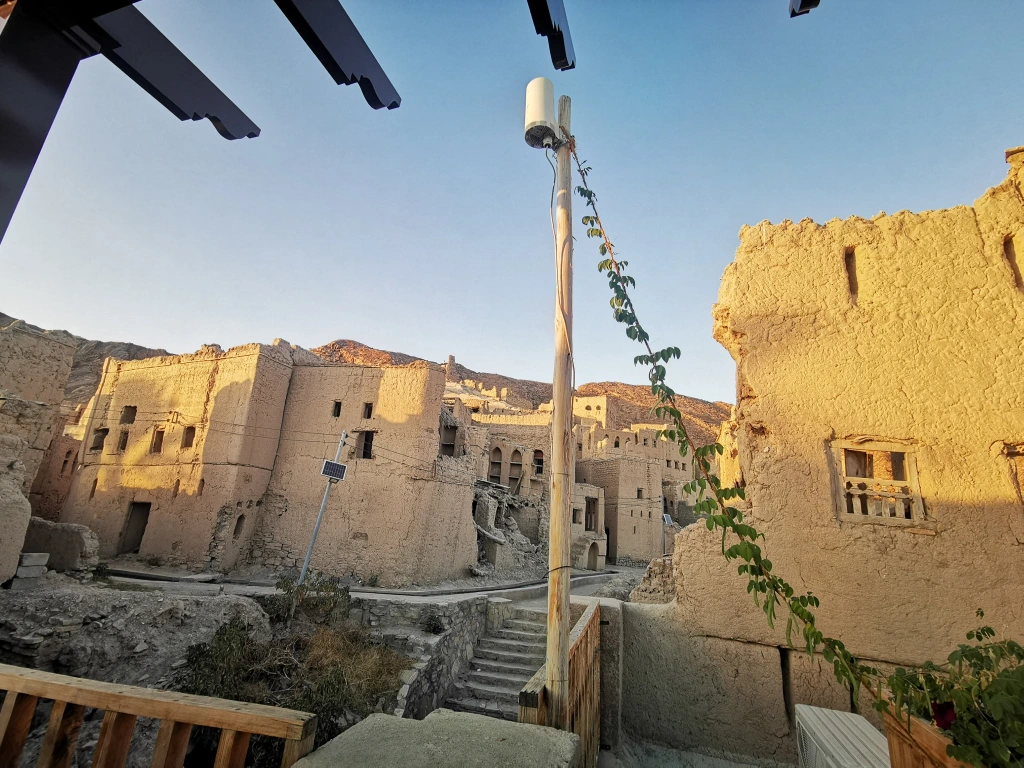
“The abandoned home may soon fade away if not
restore on time. Though there is no interference
from the ministry, it is a World Heritage site so one
should follow the ministry guidelines. The owner
who wants to restore their house or turn them into
inns, therefore, requires permission from the
Ministry of Heritage. The owner has no right to
tamper the floor plan of the house; maintaining its
traditional look is a must,” says Ali Al Mahrooqi.
Here at Birkat Al Mawz, I met Issa Nasser Al Sarqi,
who belongs to the Al Sarqi tribe and presently lives
in Nizwa. A 250-year-old mud house in this ancient
city handed over to him by his forefather is his
prized possession. With all permissions granted and
required documents correctly signed by the
Ministry of Heritage, the restoration work of this
old house is currently in progress. “The roofs and
walls of some rooms have collapsed; the doors and
windows require a restoration. More than 100
tourists visit this place daily during the winter. My old mud-house will serve the guests who want to stay here and enjoy our hospitality,” he says.
He further explained that in Arabic, the word Birkat
means “pool” and Al Mawz stands for “banana”. A
‘pool of banana’, this village was named so because
of the large number of banana plants majorly
cultivated in the past.
Strolling through the green shades of date palms
and pomegranates, it is a real challenge to find a
thick banana plantation at present.
“Why the village is named ‘Pool of Banana’?” I
queried as I spotted only a few.
Issa Al Saqri promptly replied, “It may now seem to
be a bit of exaggeration, but nearly 15 years back,
there were more than one thousand banana
plantations in this area.”
A right climate and the fertile soil makes the place
perfect for banana cultivation. “The rainwater from
the mountain which flows down to the valley brings
mineral-rich mountain soil to the farmland, which is
apt for the growth of banana plants. But now the
locals have no time to care for their farms.
Therefore there are not many banana plants now. I
plan to restore the banana farms very soon,” Issa Al
Saqri smiled.
A picture perfect mountain settlement with its
enduring legacy – Birkat Al Mawz will retain its old
charm and nature’s bounty as the local tribes
ardently plan its traditional facelift.
Content is Subject to Copyright
Copyrights Reserved Swati Basu Das

 One AMONG MANY
Leave a comment